Depilatory wax: which one to choose for different skin types and areas
Waxing remains one of the most popular methods of removing unwanted hair—and for good reason. With the right approach, results last for three to six weeks, and regular treatments gradually weaken the follicles, making the hair thinner and more sparse. However, both beginners and experienced waxers often wonder: which wax should I choose for a specific area and skin type? Let's take a closer look.
How does waxing work and what is it made of?
Before choosing a product, it's helpful to understand how waxing works at the physics and chemistry level. When applied to the skin, the wax coats the hair shaft and penetrates beneath the cuticle. After it hardens or when the strip is removed, the wax grips the hair and extracts it along with the root—this is why skin stays smooth much longer than after shaving.
What is waxing made of? Most professional formulations are based on natural or synthetic resins, such as glyceryl rosinate (pine resin) or hydrogenated polycyclopentadiene. Vegetable and mineral oils are added for flexibility, while titanium dioxide or mica provides texture. Premium formulations also contain caring ingredients such as vitamins, plant extracts, and antiseptics. The color of depilatory wax also depends on its composition: pigments and titanium dioxide create a shade that often serves as a clue to the product's intended use (pink for sensitive skin, green for areas with coarse hair, and so on).
Types of Depilatory Wax: Cold, Warm, and Hot
Depilatory wax types are usually categorized by application temperature—this is the basic classification that's best for starting your acquaintance with the product.
Cold wax consists of pre-applied strips that are warmed by hand. The main advantage is speed and convenience, as no wax heaters or preparation are needed. That's why cold wax strips are often chosen for express at-home treatments. But which is better – wax strips or wax in a jar or granules for professional use? The answer is clear: cold wax has significantly less adhesion than hot wax, it doesn't cope well with coarse and thick hair, and several strips in a row may be required to thoroughly treat one area.
Warm wax is heated to 37-40°C, applied with a spatula, and removed with depilatory paper. It's well suited for large areas – legs, back, arms – where hair is thin and shallow. How does hot wax differ from cold and warm wax? Primarily, it's the temperature (40-55°C) and the removal method: the hot wax hardens directly on the skin, forming a dense, elastic film that the technician grasps with their fingers and removes with one confident motion, without paper. This is why hot wax is considered the standard for sensitive and difficult-to-treat areas. Film wax is a separate category of hot waxes with a higher polymer content. How does film wax differ from traditional hot wax? Film wax forms a thinner and denser coating, clinging more tightly to the hair, which is especially important in areas with complex textures. Film wax types vary in resin composition and additives – some are designed specifically for bikini areas, while others are optimized for the face or eyebrows.
Product forms: granules, cartridges, jars, and strips
Depilatory waxes vary not only in temperature but also in form – and this directly impacts ease of use.
Granules are the most popular format among professionals. They are conveniently dosed, melt quickly in a wax heater, and are economical to use. The question "Can I melt granular wax for depilation in the microwave?" often arises, but the answer is no: microwaves heat unevenly and easily overheat, which changes the consistency and properties of the wax. For proper operation, use a wax heater with a temperature controller.
Cartridges with a roller head are the optimal choice for beginners and home use. They allow for an even application of the warm wax without a spatula. When choosing cartridge wax, consider the hair's stiffness: cartridges with a higher melting point and enhanced adhesion are suitable for coarse hair.
Tins and blocks are a format for experienced professionals with a large client flow. They provide maximum cost-effectiveness and flexibility.
Ready-to-use strips - cold wax for express hair removal at home. Before use, warm them up between your palms—this is the correct way to warm up wax strips, not with a hair dryer or radiator: overheating changes their adhesive properties.
Which wax to choose for different areas
This is a key question, and there's no universal answer: the best wax for hair removal is largely determined by the area being treated.
Legs and arms. Warm wax in granules or cartridges is suitable for hair removal on legs and arms. The hair here is usually thin and the area is large, so speed of application is important. Warm wax with paper strips is best for hair removal on legs: it's fast, hygienic, and economical.
Bikini and bikini area. This area requires special attention: the skin here is thin, the texture is complex, and the hair is coarse. The best wax for bikini hair removal is a hot film wax, preferably with soothing additives (azulene, chamomile, aloe). The best film wax for bikini hair removal is one that contains synthetic resin without pine resin: this reduces the risk of allergies and irritation. For a bikini area, choose a wax with maximum adhesion and flexibility.
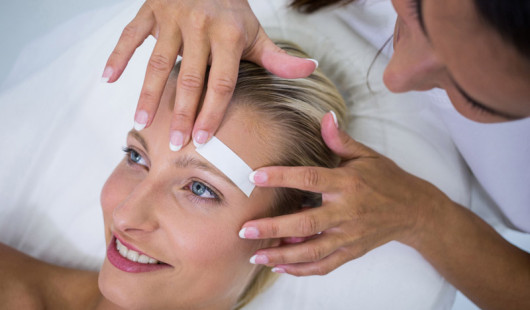
Face and eyebrows. Precision and delicacy are essential for working with the face. What's the best wax for facial hair removal? Hot film wax with a fine-grained texture, which allows for precise contouring. Eyebrow wax should be thick enough to resist smearing and hypoallergenic, as the skin around the eyes is sensitive.
Armpits. This area has thick, coarse hair and often experiences increased sweating. Here, a hot wax with high adhesion and moisture resistance is needed—a classic film or hybrid formulation.
How to choose wax based on your skin type
Choosing the right hair removal wax based on your skin type is no less important than choosing the right area.
Normal skin is the least demanding. Formulations based on natural pine resin, film waxes, and warm waxes are equally suitable.
Sensitive and irritated skin: The best choice is synthetic or hybrid formulations without natural resin. Look for azulene, bisabolol, and panthenol in the ingredients. Avoid fragranced products, as fragrances are a common cause of contact dermatitis.
Oily skin: It is especially important to degrease the surface before the procedure, otherwise the wax will not adhere properly. For oily skin, water-based formulations with a high resin content are preferable.
Dry and mature skin: Choose waxes with oils and moisturizing additives; avoid formulations with a high alcohol content.
Atopic skin: Strictly hypoallergenic formulations – synthetic resins, minimal additives, no paraben-containing preservatives. A patch test is mandatory before the procedure.
How to properly heat depilatory wax
Even the best wax will give poor results if handled incorrectly. Here are a few key rules.
To melt granular depilatory wax, use a wax heater with a thermostat that maintains the desired temperature without overheating. To heat cartridge depilatory wax, use a special cartridge heater; the desired temperature is determined by the consistency: the wax should flow smoothly, without jerking. To heat depilatory wax without a wax heater, in a pinch, you can use a double boiler—a saucepan of boiling water with a container above—but this method requires constant temperature monitoring.
To properly apply depilatory wax, use a spatula or roller in the direction of hair growth, in a 2-3 mm thick layer. Remove the hot wax with a sharp motion against the hair growth, parallel to the skin, not upwards. To apply depilatory wax to small areas (eyebrows, upper lip), use a narrow wooden spatula for precision.
To remove depilatory wax from skin if residue remains, use a special post-depilation oil or lotion: these dissolve the wax base without mechanically damaging the skin.
Can depilatory wax be reused? Using a hot wax in a professional setting is not recommended; it violates sanitary regulations. Any residue in the wax heater should be discarded after each shift.
Where to buy high-quality hair removal wax
Where to buy hair removal wax is no less important than choosing the right one. Professional wax should be purchased exclusively from trusted suppliers specializing in the beauty industry: this is the only way to guarantee the product's authenticity and valid expiration date. Counterfeit wax isn't just a waste of money; it poses a direct risk to your client's skin.
The Minoko online store offers a wide selection of certified waxes from leading international brands with delivery throughout Ukraine. Here you can find waxes for any area and skin type, receive expert advice, and take advantage of our loyalty program for professionals. High-quality materials are half the battle in a waxing procedure; don't skimp on something that directly impacts the results and the reputation of your salon.