Eyelash Glue: How to Choose the Best Option for Extensions and Home Use
Glue is a consumable material that determines literally everything: whether a lash extension lasts for three weeks or falls off on the second day, whether the client is comfortable during the procedure, and whether an allergic reaction will occur. That's why choosing eyelash extension glue is one of the most important professional skills for a lash artist.
What's in eyelash extension glue?
Understanding the chemistry of glue helps you work with it correctly and explain to clients why it's important to follow post-procedure recommendations. What's in eyelash extension glue? This is a question worth researching before your first purchase.
Professional glues are based on cyanoacrylate, a fast-hardening compound that polymerizes when exposed to moisture. This is why the humidity in the office directly affects the setting speed: low humidity makes the glue work more slowly, while high humidity makes it work faster. Different brands differ in the type of cyanoacrylate: ethyl, butyl, or methoxyethyl cyanoacrylate. The latter is considered the mildest and is more often used in formulations for sensitive clients. In addition to the base, the composition includes stabilizers, thickeners, and polymerization inhibitors, which extend the shelf life of an opened bottle. Some manufacturers add hypoallergenic components to reduce the risk of irritation. The shorter the ingredient list and the higher the purity, the higher the quality of the eyelash extension adhesive.
Types of Eyelash Glue: How to Avoid Confusion
Eyelash extension adhesives vary in several ways: curing speed, color, viscosity, and intended use. Understanding this is important for both professionals and those choosing an adhesive for home use with false eyelashes.
By setting speed, adhesives are categorized as fast (1-2 seconds), medium (3-4 seconds), and slow (5-7 seconds). Beginner eyelash extension adhesives are always slow or medium: this allows time to adjust the lash position before fixation. Experienced technicians typically use fast adhesives, which speed up the process and increase productivity. Eyelash glue is classified by color as black or transparent. The question of "which eyelash glue is better, black or clear" doesn't have a single, correct answer: it all depends on the client's technique and preference. Black glue creates an additional eyeliner effect at the base of the lashes, visually thickening the lash line. Clear glue is versatile, discreet, and suitable for light-colored or colored eyelashes, as well as for eyebrow work. Incidentally, the question of "which eyebrow glue is better, black or clear," is answered similarly: for a natural effect, choose clear.
Based on viscosity, glues are classified as liquid and thick. Liquid glue is easier to dispense and has less stretchiness—this is relevant if you're concerned about "why eyelash glue stretches": most often, this is a sign either of too thick a consistency or improper storage conditions.
How to choose eyelash extension glue: key criteria
How to choose the right eyelash extension glue is a question that everyone seriously involved in lash design asks. Below is a clear list of parameters to focus on:
Technician experience. If you're a beginner, look for a product labeled "for beginners" or choose a slow-setting adhesive with a curing time of 4-6 seconds.
Humidity in the office. If the humidity is below 40%, use fast-setting adhesives; if the humidity is above 60%, use slow-setting adhesives, otherwise the adhesive will set before you can straighten the lash.
Skin type and allergy risk. For sensitive clients, methoxyethyl cyanoacrylate-based adhesives with minimal additives are suitable.
Extension technique. For classic eyelash extensions, a standard medium-speed adhesive is sufficient; for volume techniques (2D-6D), a thinner and faster adhesive is needed.
Color. For dark lashes, use black; for light and colored lashes, use clear.
Brand and certification. The best eyelash extension adhesive is one that has been independently tested and has international safety certificates.
How to test eyelash glue for allergies and why it's essential
One of the main reasons for adverse reactions after eyelash extensions is neglecting to test it. How to test eyelash glue for allergies is essential knowledge for every lash artist.
A standard patch test is performed 24-48 hours before the procedure: a small amount of glue is applied to the skin behind the ear or on the inside of the wrist. If no redness, itching, or swelling occurs within 24 hours, the adhesive is compatible with the client's skin. Understanding how to test for an allergy to eyelash glue is especially important for clients with atopy or a history of cosmetic reactions: in such cases, it's best to choose a hypoallergenic adhesive and perform a patch test immediately.
How to Store Eyelash Glue: Rules to Extend the Life of the Bottle
Even the most durable eyelash extension glue will quickly lose its properties if stored improperly. This section is especially relevant for those just starting to build their workflow.
How to Properly Store Eyelash Extension Glue:
Hold the bottle upright, with the neck facing upward. This prevents the base of the cap from drying out and makes it easier to open the eyelash glue after a break.
Store in a cool, dark place at 15-25°C. Refrigeration is only suitable for sealed bottles; sudden temperature changes when removing the bottle will cause condensation inside the bottle and accelerate polymerization.
After each use, thoroughly wipe the neck with a dry, lint-free cloth and screw the cap on tightly.
Avoid exposure to direct sunlight.
The shelf life of unopened eyelash extension glue is typically 6-12 months, depending on the manufacturer. Opened eyelash glue can be stored for no more than 4-6 weeks, provided all conditions are met. After this period, the composition changes viscosity, the polymerization rate slows, and the durability of the result decreases. The expiration date of eyelash extension glue is always indicated on the packaging – refer to it and do not use expired material.
Black or clear, resin or glue: we address common dilemmas
Debates regularly arise among lash artists about which is better: glue or resin for eyelash extensions. Technically, these are different products: resin has a thicker consistency and is used primarily in Japanese lamination and curling techniques. Cyanoacrylate-based glue is used for classic and volume extensions. If you're looking for the best eyelash extension glue, consider specialized formulations designed specifically for this procedure: they have a gentler formula and are not intended for individual eyelash extensions.
What can replace eyelash extension glue? This is a question that beginners often ask, but there's no good answer. Neither medical glue nor cosmetic adhesives for false eyelashes provide the durability and safety of professional glue. Using substitutes can lead to chemical burns or loss of your own lashes.
How to remove glue and what to do with residue
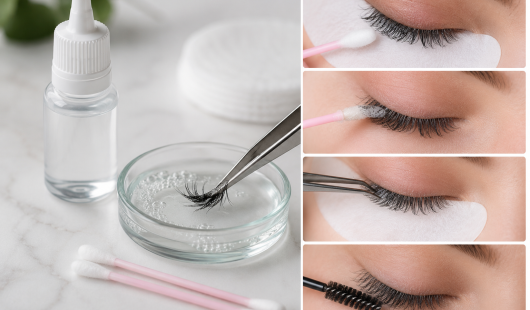
How to remove eyelash glue correctly is knowledge that will protect both your client's lashes and your lash technician's reputation. Cyanoacrylate is dissolved by special removers—gel, cream, or liquid. How to remove eyelash glue without damaging it? Gel remover: it works slower than liquid, but is gentler and more precise. Liquid remover is suitable for experienced lash technicians who control the application time. To dissolve eyelash glue at home if a client decides to remove the extensions themselves, use oil. Coconut, burdock, or special makeup remover oils soften the seam and allow the extensions to be gently removed without mechanical stress. Never attempt to remove the extensions by force, as this can damage the natural ones.
Where to buy good eyelash glue
The Minoko online store offers a wide range of certified adhesives from trusted brands—for every experience level, technique, and client type. Here you can find everything from a beginner's solution to a professional, fast-acting adhesive for a busy workflow, get a consultation, and take advantage of our loyalty program. High-quality glue is an investment in results that speak louder than any advertisement.